
With colour accuracy under the spotlight, it’s not just about delivering on the perfect match but also matching your customer’s expectations. Here, Valspar Trade explores the science of achieving that perfect match, helping you to be more confident with colour.
As a nation, we’re arguably getting braver with colour, used within homes and living spaces to express an individual personality and add character to a property. As a decorator, you’ll likely have already experienced the shifting trend.
From colour being limited to an exclusive ‘feature wall’, to the rise of colour drenching (the bold technique where an entire room is painted in a single colour, from skirting boards to ceiling) and colour capping, where a gradient of related tones from the same colour family are used on different levels of a room. For many customers, Pure Brilliant White is out and colour is most definitely in.
Tasked with bringing your customer’s vision to life, you’re under pressure to match the right colour paint, whether that’s a truly bespoke shade or one of thousands of pre-selected chips.

All about the pigments
Of the components that make up paint formulations, it is the pigment that holds the key, providing the whiteness, colour, coverage and bulk of paint.
While there are two main types of pigment (prime and extender), prime pigment gives the paint its colour or whiteness. Titanium Dioxide is one example, the predominant white pigment in high-quality paints. It effectively disperses light, meaning it provides exceptional whiteness and high levels of opacity.
It is because of this that it is also one of the most expensive pigments available. While the majority of paint products will contain it, cheaper paints may have lower proportions to help keep costs down.
At Valspar Trade, the pigments we use are cleaner and finer, creating a truer colour and allowing for easier application.
The science behind a tinting machine
A perfect colour match also relies on the technology, spectrometer and database used in store, as well as the strength of the colourants.
Typically, spectrometers will analyse a colour sample, breaking it down into its constituent pigments. This will then be used to determine the closest matching colour from a paint manufacturer’s fan deck or create a custom formula from an extensive database.
Carefully calibrated, the machine will dispense the perfect combination of pigments required to create the desired colour, before a different machine shakes the can vigorously, ensuring the pigment is thoroughly combined with the base formulation. This ensures a smooth and consistent colour.
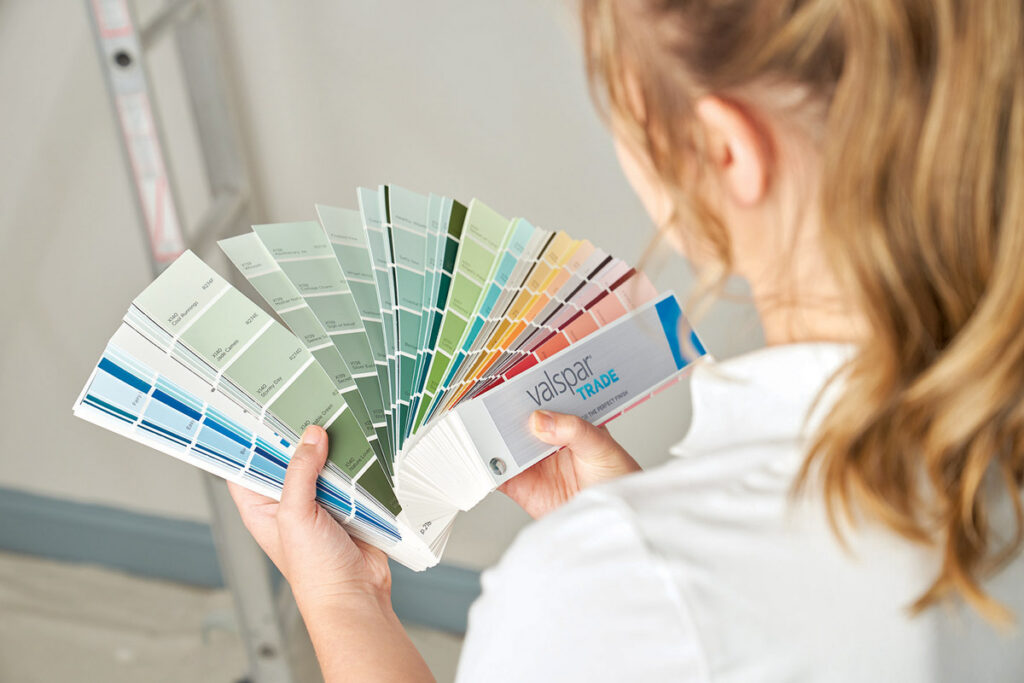
Colour, colour, colour
As well as looking at a manufacturer’s pre-selected shades, it’s also important to consider their matching database. Larger databases can create a custom blend of pigments, leading to a more accurate match. With 2.2 million options, Valspar Trade can match to 99-100% accuracy.
The new MetaVue™ machinery, exclusively at TradePoint, means colour matching to even smaller (at least 2mm diameter) and more complex, multiple colour sample sizes. All bespoke colours are saved on the main TradePoint database, meaning your or your client can easily access the same paint colour, whether that’s days or years down the line.